
Not That I’m Complaining, But… Why Is There a Dog in My Therapy Session?
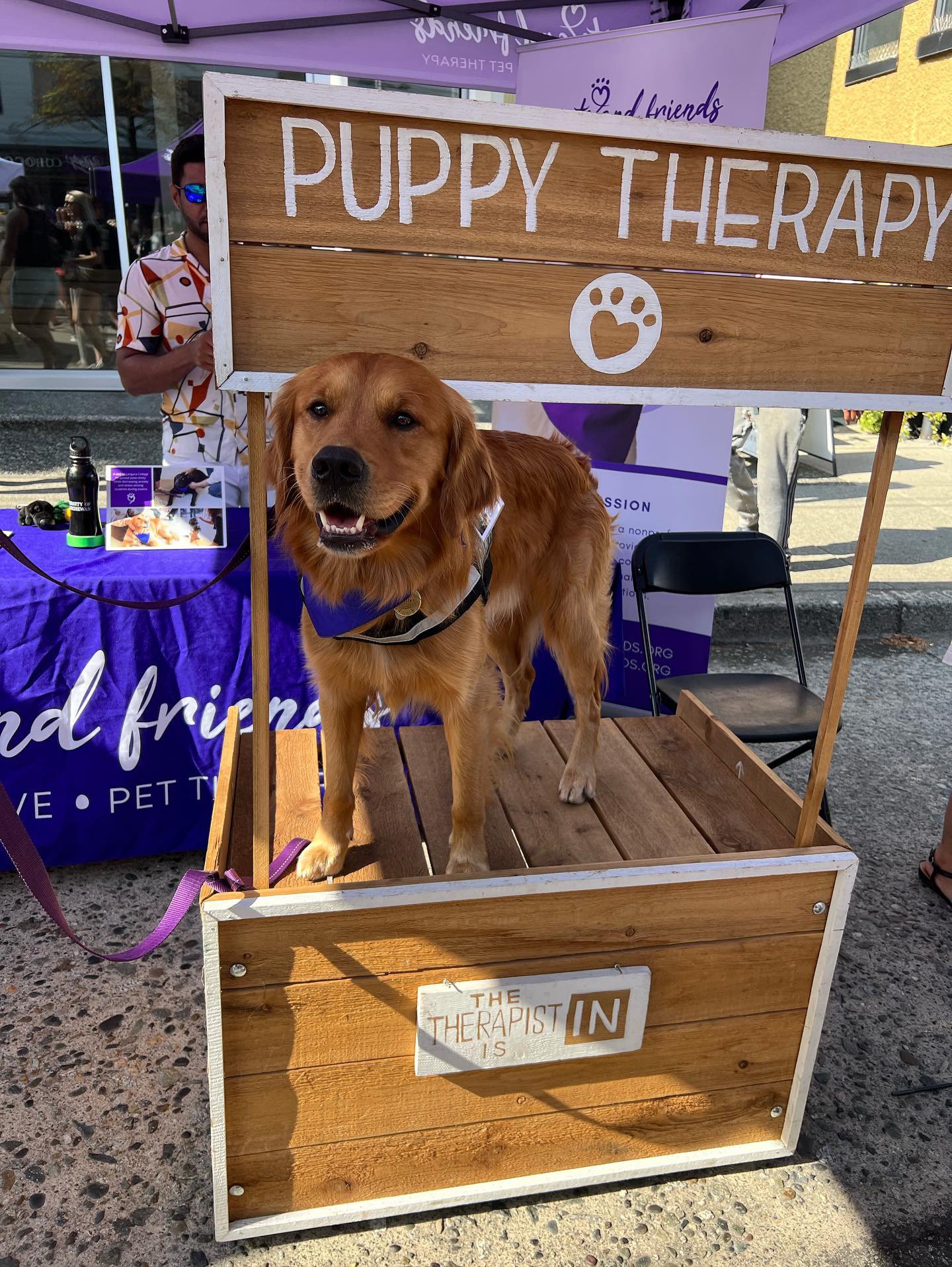
Healing, with a side of dog hair.
If you’ve ever seen a dog like Parker included in a therapy session, you might wonder what role they play. The short answer is: more than you might think.
Therapy dogs are not just comforting presences. They are relational partners in the work of healing. Research shows that their presence can reduce stress, increase oxytocin (a hormone tied to connection and trust), and help people feel emotionally safe enough to open up (Handlin et al., 2012; Binfet et al., 2021). In many cases, a therapy dog helps the nervous system settle, which can make it easier for clients to access their thoughts, their emotions, or simply their breath.
For clients living with trauma, anxiety, grief, or attachment wounds, a therapy dog can be a steady co-regulator. Their quiet companionship often helps soften moments that feel overwhelming. When a dog like Parker sits nearby, offers gentle eye contact, or rests his head close, it can shift the tone of a session in subtle but powerful ways (Parish-Plass, 2021; Germain et al., 2018).
This can be especially supportive for clients who have difficulty trusting people, or for those who have not felt safe in traditional therapy settings. A therapy dog’s presence can create a sense of emotional grounding and support that is felt through the body, not just talked about. For some clients, touching the dog’s fur or watching them move around the space offers a way back into the moment.
Therapy dogs also offer meaningful support for specific populations. Children and youth often find it easier to engage when a dog is present, especially when they are feeling nervous or unsure (Kamioka et al., 2014). Adults with ADHD, autism, or sensory sensitivity may feel more regulated in the presence of a calm animal (Trevisan et al., 2017; Liu et al., 2024). Older adults and those living with isolation or loss often describe therapy dogs as offering comfort, companionship, and something to look forward to (Berget & Braastad, 2021).
The human-animal bond is a powerful relationship. It supports connection in ways that do not rely on words, and it invites a different kind of presence. In therapy, this relationship is not incidental. It is co-created and supported through training, consent, and ongoing care for the well-being of both the client and the animal.
For those who are curious, Parker sometimes joins me in sessions, depending on the needs and preferences of the client. In some cases, he may be included in nature-based or walk-and-talk therapy, where his steady presence adds another layer of grounding and connection.
If you are wondering whether working with a therapy dog might be right for you, I invite you to reach out. Parker and I are here, ready to meet you where you are.
SOURCES
Binfet, J.-T., Passmore, H.-A., & Davidson, H. K. (2021). A conceptual model of animal-assisted therapy with therapy dogs. International Journal of Environmental Research and Public Health, 18(6), 2898. https://doi.org/10.3390/ijerph18062898
Berget, B., & Braastad, B. O. (2021). Animal-assisted interventions in mental health: A review of research and practice. In K. R. Blashki (Ed.), Animals in our lives: Human–animal interaction in family, community, and therapeutic settings (pp. 203–222). Federation Press.
Germain, S. M., Wilkie, K. D., Milbourne, V. M., & Theule, J. (2018). Animal-assisted psychotherapy and trauma: A meta-analysis. Anthrozoös, 31(2), 141–164. https://doi.org/10.1080/08927936.2018.1434044
Handlin, L., Nilsson, A., Ejdebäck, M., Hydbring-Sandberg, E., & Uvnäs-Moberg, K. (2012). Associations between the psychological characteristics of the human–dog relationship and oxytocin and cortisol levels. Anthrozoös, 25(2), 215–228. https://doi.org/10.2752/175303712X13316289505468
Kamioka, H., Okada, S., Tsutani, K., Park, H., Okuizumi, H., Handa, S., ... & Mutoh, Y. (2014). Effectiveness of animal-assisted therapy: A systematic review of randomized controlled trials. Complementary Therapies in Medicine, 22(2), 371–390. https://doi.org/10.1016/j.ctim.2013.12.016
Liu, M., Li, L., Pan, Z., Liu, D., Tang, S., & Hu, Y. (2024). Effects of animal-assisted therapy on social interaction and regulation in children with autism spectrum disorder: A systematic review and meta-analysis. Children and Youth Services Review, 156, 107303. https://doi.org/10.1016/j.childyouth.2024.107303
Parish-Plass, N. (2021). Animal-assisted psychotherapy: Theory, issues, and practice. Purdue University Press.
Trevisan, D. A., Roberts, N., Lin, C., & Birmingham, E. (2017). How do adults and teens with self-declared autism spectrum disorder experience eye contact? A qualitative analysis of first-hand accounts. PLoS ONE, 12(11), e0188446. https://doi.org/10.1371/journal.pone.0188446
Zilcha-Mano, S., Mikulincer, M., & Shaver, P. R. (2011). An attachment perspective on human–pet relationships: Conceptualization and assessment of pet attachment orientations. Journal of Research in Personality, 45(4), 345–357. https://doi.org/10.1016/j.jrp.2011.04.001
